

Yes, the S&P 500 was down last week, falling 1.5%, but as we’ve been talking about throughout the year, this has been the year of diversification. Technology-oriented US large cap stocks led declines, but value stocks held up fine, as did developed international stocks. And that brings us to the theme of Carson’s 2026 Midyear Outlook: “Still Riding the Wave.” A surprise for many investors this year has been that the best way to invest in the AI boom so far has been a broad equity overweight and exposure across markets because, as we discussed in our full-year Outlook, the inputs to AI are everywhere. That’s held up so far in 2026 as we’ve seen strong market breadth, and a broad market is usually a healthy market.
We’ve been bullish for years, and we believe the second half of this year may see additional gains thanks to the combination of accelerating artificial intelligence (AI) investment, strong corporate earnings, fiscal expansion, and a Federal Reserve expected to look past elevated inflation.
We are raising our full-year S&P 500 total return forecast to 15-18%, up from our prior 12-15% target, after the index delivered a 10.2% total return in the first half of the year. After a huge spike in oil, the war in Iran, and equity volatility in March, many other places cut their targets, but we never did. Even when the S&P 500 was down close to 5% for the year, we remained steadfast that the bulls would once again prevail in 2026.
Carson’s Investment Research team expects bonds to finish the year with returns of 3-5%, supported by higher starting yields but challenged by persistent inflation and a Federal Reserve that is likely to remain on hold.

There have been many big stories this year so far, from the war in Iran, to new leadership at the Fed, to ongoing inflation worries, to oil surging, to a historic bounce in equities in the second quarter, to consumers feeling down and out but still spending more and more. In the end, though, earnings drive long-term stock gains. At the start of the year, the S&P 500 was expected to see earnings growth of 14% in 2026, and that is now expected to be 24%. Earnings drive long-term stock gains, and earnings gains are the main reason stocks have done well this year so far.

AI remains a big part of our economy, as the scale of the AI infrastructure buildout is a central driver of the current market environment. Over the last five quarters (through the first quarter of 2026), real GDP growth averaged 1.9% annualized, with real investment spending on information technology equipment and software contributing roughly 0.9 percentage points per quarter. 2026 capital expenditure estimates for major technology firms have increased to approximately $740 billion, or about 2.3% of GDP, more than four times the level seen in 2023.

Inflation has remained stubbornly high and is a key risk the rest of this year, but we came into the year expecting a year of inflationary growth, so we’ve been positioned for this. Still, the massive demand for AI has created historic moves, including AI-related bottlenecks, with the PCE price index for computer software and accessories, which historically has steadily declined, rising at a 64% annualized pace through April 2026.

Where are we different than many others? There are two main places. The first is we think the Federal Reserve Bank (Fed) is on hold this year and won’t raise rates, and even a single hike may still allow the economy to run hot. Many expect them to potentially hike, maybe as soon as the next meeting in July, but we continue to think they may hold off, which would likely help the economy and markets while creating a difficult backdrop for bonds, offset somewhat by strong yields. Nevertheless, higher borrowing costs will likely drag on certain areas of the economy, especially housing.
The second place we are different is that we said all year the labor market was in better shape than it appeared under the surface. The past three months, we’ve seen things pick up, with the economy averaging 110,000 jobs added a month, which might not sound like much, but remember the economy added only about 120,000 jobs the entire year last year. Should the labor market remain steady in the second half, it would provide a nice backdrop for consumers and potentially a boost to confidence.

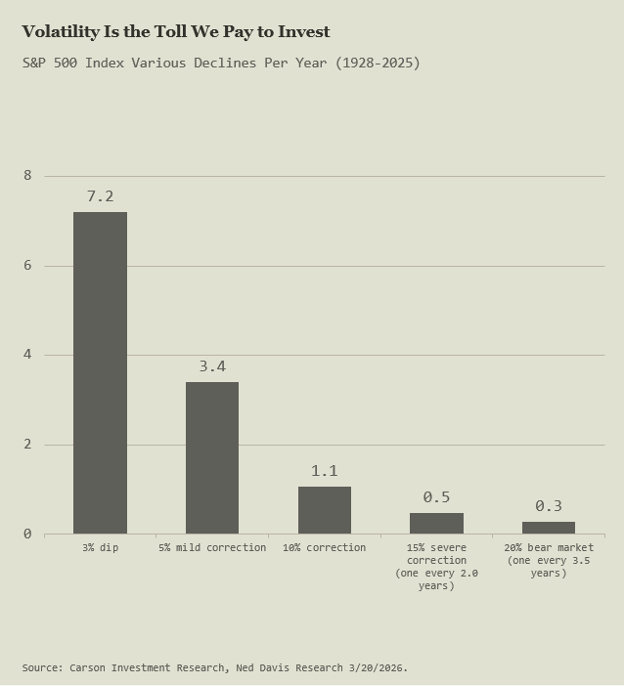
One big story the back half of this year will be midterm elections. We continue to stress not to mix investing and politics, but be aware that midterm election years tend to be quite volatile. In fact, midterm years tend to see the largest peak-to-trough correction out of the four-year presidential cycle (although stocks have also been up an average of more than 31% a year off midyear lows).

One big concept we’ve shared for a couple years now is this bull market isn’t as old as you might think. We found that once prior bull markets made it past their third birthday (which was last October for our current bull market), they usually make it to at least their fourth birthday, with many lasting many, many more years.

Additional takeaways from the 2026 Midyear Outlook include:
- We remain overweight equities relative to bonds, supported by an inflationary growth environment, strong earnings, expanding profit margins, and continued AI-related capital spending. It’s important to remember that lasting gains come from fundamentals, not sentiment.
- The team believes recession risk over the next year remains low, with job growth improving, unemployment holding near historically low levels, and nominal consumer spending running well above recent trends.
- Carson expects the 10-year Treasury yield to end the year near 4.5%, with a bias toward lower outcomes, and continues to target below-benchmark interest rate sensitivity within fixed income allocations.
- Carson continues to favor balanced global equity exposure, noting that while the U.S. remains the leader in AI innovation, the AI trade is broadening internationally, and relative valuations outside U.S. large-cap growth have become more attractive, with large gains in particular in South Korea and Taiwan.
- The team notes that midterm election years have historically brought larger market pullbacks, but we also caution against letting political views drive investment decisions, as broader macro forces tend to matter more for markets.
We appreciate you reading what our team has to say about markets and the economy, as you have many places to get this information. We won’t always be right, and we won’t always be wrong, but we will always be honest and follow the data, even if it means holding unpopular opinions. We believe that’s the only way to provide trusted, timely market analysis.
For more depth, take a closer look at Carson Investment Research’s Midyear Outlook 2026: Riding the Wave.
S&P 500 — A capitalization-weighted index of 500 stocks designed to measure performance of the broad domestic economy through changes in the aggregate market value of 500 stocks representing all major industries.
The NASDAQ 100 Index is a stock index of the 100 largest companies by market capitalization traded on NASDAQ Stock Market. The NASDAQ 100 Index includes publicly traded companies from most sectors in the global economy, the major exception being financial services.
The views stated in this letter are not necessarily the opinion of Cetera Wealth Services LLC and should not be construed directly or indirectly as an offer to buy or sell any securities mentioned herein. Investors cannot invest directly in indexes. The performance of any index is not indicative of the performance of any investment and does not take into account the effects of inflation and the fees and expenses associated with investing.
A diversified portfolio does not assure a profit or protect against loss in a declining market.
All investing involves risk, including the possible loss of principal. There is no assurance that any investment strategy will be successful. This information is from sources believed to be reliable, but Cetera Wealth Services, LLC cannot guarantee or represent that it is accurate or complete.
9031678.1-0726-C
